Monday, January 10, 2011

An American in Israel

Hello, Jerusalem. We have arrived. And fortunately, we planned ahead enough to get into the city early enough to do something. When we arrived at our hotel--the Caesar Premier, which is pronounced a variety of ways, apparently--our room wasn't ready. So, the concierge locked up our luggage, handed us a city map and guidebook, and scooted us out the door towards the Mahane Yeuda Market down the road.
  
This place was packed. It was half indoor, half outdoor, and had about 800 times the amount of food you'd find at a typical American grocery store. There were fresh fruits and veggies, meats, bakeries, spice shops, oil shops, sweet shops, candy shops, olive & nut shops, eateries, flowers, boutiques and housewares. You name it, they probably have it. The market is a blur of color and intoxicating scents. This is where the locals come to get their goods. It's much different than the Arab markets in Cairo, where the shop owners stand outside their stores and aggressively hassle you inside and practically force you to buy something. Here, the atmosphere and the people are calm, and the prices are actually set :). 


After unexpectedly buying a variety of foods (all of which were ridiculously cheap, I might add), we headed back to the hotel to check into our room. About thirty seconds after I put my bags down, I discovered a white blotch on the front of my backpack. The substance? Paint. The culprit? A freshly touched-up wall near our window that had not yet dried. I grabbed the bag and ran down to the lobby for assistance. We scrubbed with hot water until the maintenance man showed up, poured kerosene on a cloth, and saturated the marks. That should make me extremely popular at the airport on my way home. Hopefully they don't have dogs looking for explosives...or backpacks that suspiciously smell like kerosene. Fingers crossed it'll fade over the next week. 


After that, we went on a lovely one and a half hour tour of the local area on foot, which only became a "tour" after we discovered that our map was trash and we couldn't locate the Bible Lands or Israel Museum we were trying to get to before closing time. Then we topped off the evening with dinner at our first sit-down restaurant all trip. 


Tomorrow we go to the Old City. Eyes peeled and hearts open...this ought to be good.

Sunday, January 9, 2011

Massada and the Dead Sea

“The mountain is closed.” Crap. So much for crossed fingers. We came to Massada hoping to find a secret, alternative way up the mountain to see the ruins. Unfortunately, all our planned pleading wasn’t going to get us anywhere. The funicular, which is typically closed for one day out of the year for inspection, is now closed for the next several months for their “once every 10 year repairs.” I guess it’s important that the cable car doesn’t plummet to the sharp rocks below, but we were really looking forward to Massada. Of course, they couldn’t leave the snake path—the only other way up the mountain—open. It’s closed too.  “But, the museum, the gift shop, and the restaurant are all open,” the gatekeeper told us. Fantastic. So at 8:30 a.m., we hiked up the steep driveway to the top of the visitor’s center next to the mountain that is Massada. 

The museum was actually pretty sweet. It had an interactive audio guide and life-sized figurines that demonstrated different scenes from Massada’s history (from Herod’s construction to the rebel’s last stand against the Romans). It also featured several artifacts that were discovered in the 1960s. Of course, this is no replacement for actually going and SEEING the site, but at least we got to do something. 

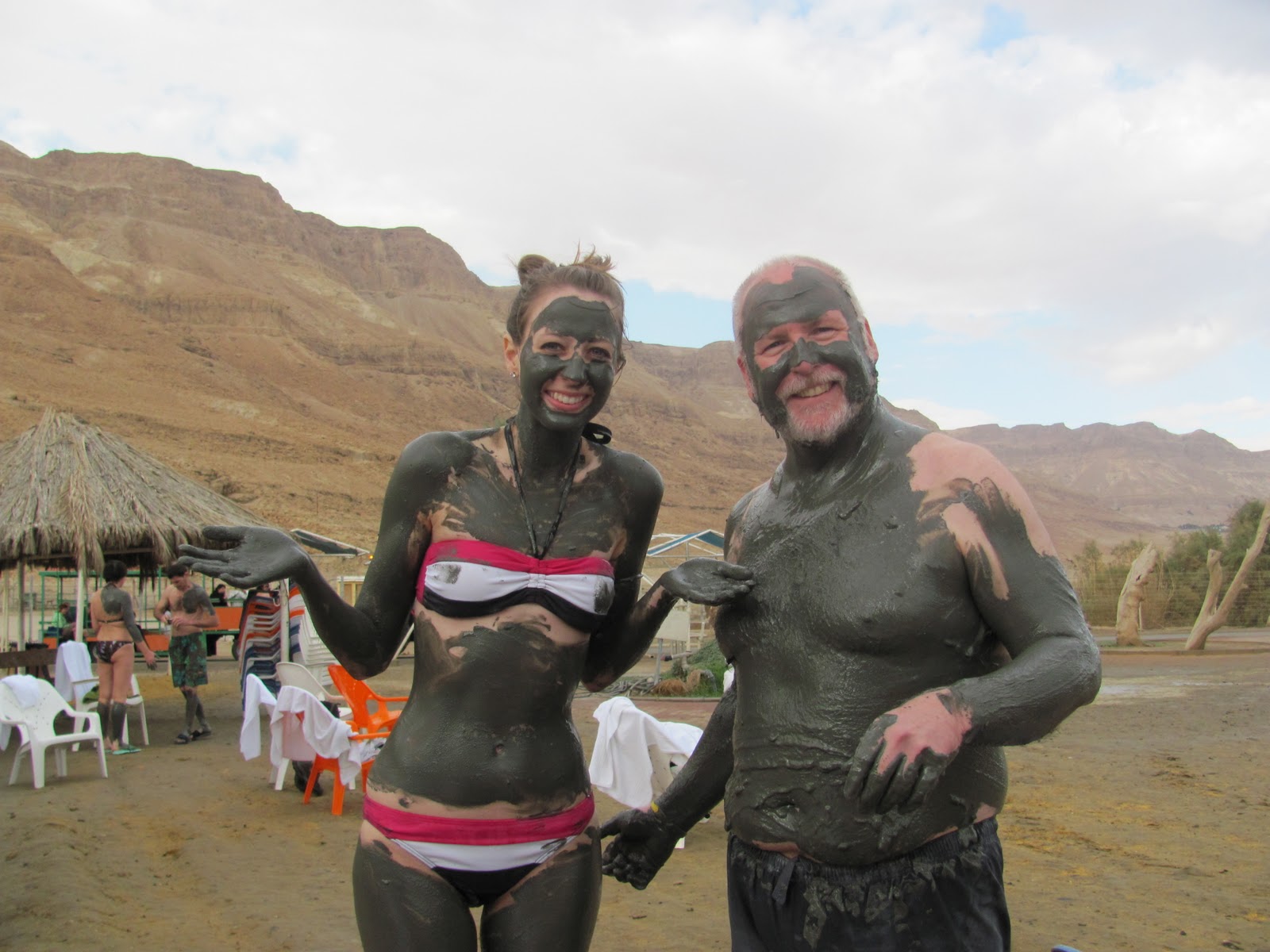
The weather today was a lot like yesterday’s except it was deceptively warm and sunny all morning, and was only cool, cloudy, and windy later when we decided to actually put on our swimsuits and get into water. This was our last day to enjoy the Dead Sea spa at Ein Gedi. I read up on the benefits of Dead Sea mud last night, and was prepared to switch up my routine. Today, while dry, we went straight for the mud. Kevin opted out, but I slathered the mud onto my dry skin, pulled down my hair and dipped my head into the vat. In order to get the full benefits of Dead Sea mud, you have to allow it to dry before removing it. So we skipped the train and chose to walk the 10 minute stretch of sidewalk to the beach. I could feel the mud drying and beginning to crack. It was getting harder to move my face, and my hair was in one stiff, disgusting bunch at the side of my head. I passed a small family when we were near the water. The young girl with them took one look at me and ran behind her mother in fear. I'm sure I will forever enter her nightmares.

I rinsed my face in the fresh water tub and bobbed in the much cooler Dead Sea, scraping the mud mask off until I was finally free. When through, we rinsed off again in the cool fresh water showers (which are horrible when the wind is blowing...and was it ever blowing), grabbed towels and hopped on the tram back to the building so I could shower and get ready for my massage/facial.
**side note: speaking of nightmares, there is an un-Godly amount of overweight men in speedos here. It's painful. There should be rules about those kinds of things. Oh wait...there ARE. It's called common sense people. Please, spare us.**
I think everyone here may be in love with me. I keep magically getting freebies. The guy at the front desk at the spa gave Kevin and I free cups of grapefruit juice (bear in mind, this is a tourist hot spot with very set, jacked-up prices), tried to convince me I didn't need a facial because I'm "already sooo beautiful," and THEN gave me free coffee vouchers. Yea. Then the "lifeguard" guy on the beach offered me tea/coffee because I was cold, and I hitched a ride with him and some other spa employees I met back to the kibbutz so I didn't have to wait another 45 minutes for the last bus, AND they showed me where the is a BAR on the grounds! So yea. Needless to say, that's where Kevin and I spent a majority of our evening (everything is outside, so for the last few nights we haven't done anything after dark).

Tomorrow we leave for Jerusalem, which is about an hour and a half away from here. I'll miss this place, though. It was fun, beautiful, relaxing, and probably my favorite social stop so far.

Saturday, January 8, 2011

"Welcome to Ein Gedi, the lowest place on Earth"

Have you ever been low? The Dead Sea is known for being the densest, saltiest body of water on Earth, and its minerals are widely known for being beneficial for your skin and health. Which, of course, is part of the reason we're here. 

Dead Sea "sand"  = soft and inviting
This morning after breakfast we took a quick hike over to the edge of the kibbutz where the Natural Reserve is located. It was locked, and the person bearing the key was no where to be found. But one thing was clear: the weather wasn't looking so hot. And by not hot, I mean cold. We had been told by several people we met on the trip that the Dead Sea has it’s own little micro-climate and it’s usually warm year-round. Well today was spa/Dead Sea beach day, and temperatures were in the high 50s. There were heavy rain clouds looming about, and a chilly wind that was unmistakably stormy. Our day was not looking good. But within moments, the sky opened up and the sun came out, warming the air 10 degrees and causing us to quickly peel off our jackets. Then clouds again. This would be our pattern all day. 

The spa associated with the kibbutz (and included in the cost) is a five-minute trip down the road. A quick walk to the beach via wooden boardwalk brings you to several meters of white, soft and fluffy-looking sand that is actually hard, sharp salt crystals ready to rip the flesh off of your unsuspecting feet in a matter of seconds. And yes, my knowledge comes with a price. Did I naively and joyously skip into the “sand” only to learn its true evil nature? No. But my flip flop did fall off a few times when I was wading in shallow water, sending me into an agonizing struggle to stand and retrieve it so I wasn’t standing in concentrated salt water with fresh wounds. 

But once you get passed the tricky, shallow waves, all you have to do is sit and let the density of the water pull you back up to the top. Then you float! It feels like laying on an air mattress and the water leaves a grainy film on your skin. The water was unlike anything I'd ever been in. The sun would come in and out of the clouds and it was relatively warm, but the wind was strong and cold. The minerals in the water must have provided some sort of wind block, because the moment we rinsed off in the fresh-water showers, we were freezing and grasping for our towels. 

The sea itself, however, was stunningly beautiful. With a name like "The Dead Sea," I was expecting sort of murky, gray waters. These, however, were crystal clear and a bright turquoise color reminiscent of water from the Caribbean. The white salt shores also make up the bottom of the sea and you can clearly see the mountains on the Jordan side, a mere 17 km away. 

After our bob-and-soak, we headed to the mineral mud baths. Now, when I hear "mud bath," I envision hot tub sized pools filled with warm mud that you sit in to relax and let your skin absorb the minerals. Instead, there were giant vats of cold, slimy, Dead Sea mud that you scooped up with your hand and rubbed all over your already cold skin, including your face. Then once you were covered, you had to stand in the cold and try to let it soak in for 10 minutes before rinsing in the hot sulfur showers, followed by a rinse in the COLD fresh-water showers. My skin has never felt so smooth. I would also like to take a moment to say that I actually bought a Dead Sea mud mask from Target last year for $10 and it did feel exactly like the gunk I was spreading all over me. That means I probably used like $80 worth of mud today. This stuff ain't cheap! I'm pretty tempted to go down there with a water bottle and smuggle some out. Except it'd be hard to convince the spa employees that the thick, gray matter in my water bottle is actually something I can drink. Maybe I'll come away with some salt instead.

To warm up, we briefly soaked in the indoor sulfur pools, which were like hot tubs you can bob in, before exploring the outrageously overpriced spa gift shop and hopping on the shuttle back.

For tomorrow, we planned a trip to Massada. Unfortunately, our visit falls on a short period in January when the funicular is being tested for stability, so there's a possibility the entire park may be closed. Regardless, we're going to try (fingers crossed!). Then we'll spend the later part of the afternoon back at the spa where I'm planning on having a combination Swedish massage and facial after more bobbing and mud bathing.

Stay tuned. 


Friday, January 7, 2011

From sea to shining sea.

 Well, it's official. I am at the infamous Dead Sea. Specifically at a kibbutz near a nature reserve called Ein Gedi. This place is like an oasis in the middle of a very dry stretch of mountainous Israel. The hotel-resort rooms are surrounded by blooming botanical gardens and one side of the land faces the mountains while the other faces the glimmering sea. Presently, I'm listening to an Israeli folk group that has come to put on a concert for the kibbutz. The simple rhythms combined with the fluctuating vocals creates a sound that is foreign but fascinating to me. Of course, I'd have better luck making out German lyrics, but this insignificant fact only adds to the intrigue of the music.

The three hour drive to Ein Gedi from Eilat showed us the side of Israel we hadn't seen on the way down. As a country, Israel is so small that traveling to any city is nothing more than a day's drive. A three-hour bus drive presents many opportunities for entertainment: reading, sleeping, playing games, or even chatting with the friendly person next to you. But personally, I prefer to just watch the land. There's something peaceful about observing how the geography changes and moves. Maybe I've just taken so many road trips with my family that I feel like I need to drive through a place to really get a feel for it. In southern Israel, a lot of the terrain looks very similar. There's little vegetation and water is sparse. But look closely and you'll see that the beauty of the desert lies in the curves of the mountains and the brightly colored minerals that dance across the face of the rocks like ribbons. Simply glance and you'll miss it. The Red Sea got its name from the red color of the mountains that surround it. As you move further into Israel (and Jordan, which you can constantly see across the valley/sea), the red gradually fades to lighter and lighter shades of pink. 


When our bus finally reached Ein Gedi, our driver stopped, hollered for anyone going to the kibbutz to get off, and left us at the bottom of a large, steep, hill looking longingly up at the resort. A quick glance to the left and the right revealed few, if any, cars on the road. Calling a cab was out of the question. So, we grabbed our bags, which thankfully had wheels, and began the hike. About halfway up, several cars heading back to the hotel from the resort spa passed us by, many actually rubber-necking as if to say, "wow, that really sucks...too bad you don't have a car like we do" Finally one of the cars pulled over in front of us, popped their trunk and offered us a ride to the top of the hill. They were heaven-sent. We checked in (a grueling process in itself since the woman at the desk barely knew how to use a computer, much less actually input my credit card information), took a look around the luscious grounds, and then headed for kibbutz-style dinner across the campus. The dining hall at the kibbutz looked like a super upscale Luby's. It had high ceilings with a large central chandelier and dozens of numbered tables, waiting for hungry patrons. There were several stations for food, and the options were limitless. Needless to say, we weren't disappointed with our selection, and we'll have the next few days to decide which are our favorites. 


Sundown on Friday to sundown on Saturday is Shabbat--the Jewish Sabbath and day of rest. We arrived just before it began, which is fortunate because everything from shops to all types of public transportation completely shut down between those times. The service took place in another part of campus (which is unfortunate because I wanted to sort of hang around and observe), but dinner showed many of the kibbutz residents and visitors dressed in their "Sunday" best for the evening.

Tomorrow we'll begin our Dead Sea spa treatments and the next day head to Massada to hike. Come morning we'll really get a chance to see what the kibbutz is all about.

"If you've never had a Turkish bath..."

You've never really bathed. Trust me. I didn't really believe it myself until I had one. Our hotel, The Amra Palace in Petra, Jordan, has one built in. The moment we dragged ourselves through the door and up to the counter, we were presented with a listing of the daily specials: turkish bath, jacuzzi, tea, and unlimited internet for 13 dinars. "What exactly is a Turkish bath?" I asked everyone around.  The most I got were partial explanations, and from the sound of it, it was horrible. So like any good travelers, we decided to hop on board. 

If you've never had one, your first Turkish bath is quick and intimidating at best. You start by wearing a sheet. The bathers throw you into a detox room that is so hot and filled with steam that you can't see or breathe, and you're expected to stay there until they come and get you. If you're feeling particularly masochistic, you can pick up a bowl of cool water and pour it down your steaming back. When they're ready, they pull you into a room, throw you face down on a table, and proceed to scrub you down with three types of soaps and an abrasive cloth. Then they harshly massage you and pour hot water across your limbs until you're fully rinsed. Then they peel you up, flip you over, and start again. When finished, they wrap you up in towels and toss you into a room where you sit, sip tea and quietly bond with everyone else who was just exposed to the same invasive cleaning process. And relax. If nothing else, it was a fantastic way to wash off the grit of our busy day.

 
Sitting at the top of one of the highest climbing points in Petra, we had a brief moment to look over the vast expanse of dirt and carved sandstone that has become such an important part of our trip. We made it. PETRA. It was here. Of course, because there was very little written about the city before it was mostly destroyed by earthquakes, there are only archaeologists' theories that leave much to be desired about what was in Petra and why. So a lot is left to the imagination. There were grand tombs and carved facades that were believed to be burial grounds or temples for the peoples' various deities. There was a Romanesque amphitheater and even pillars that were reminiscent of Greek times. Our Eco Desert Tour guide lead us on a guided trek, and then finally let those of us spending the night explore on our own. 

It's impossible to do Petra in a day. You could be there for weeks and still not see everything. The city is too expansive. But following the main paths through the park take you through the siq and to some of the most impressive sites. There's nothing like exploring something to feel a real connection to it. Countless summers with my family in Colorado prepared me for the climbs up stairs and on top of rock formations, in caves, and around bends, but a thousand summers couldn't prepare me for the views. By the end of the day, Petra had taken its toll on us. After several hours of driving and border crossings, we hiked 12 kilometers in all. We were sunburned, windburned, covered in "valuable" mineral dirt (according to the local Bedouin children, of course), and had gone through so many drastic temperature changes that our bodies finally registered any temp as just "fine." But every second was worth the trouble. 

Also, as a side note, the entire valley is called Wadi Musi because it's the Valley of Moses; the valley the Israelites are said to have moved through during the Exodus from Egypt. On top of one of the mountains (called the Mountain of Aaron) is a shrine which is said to be the tomb of Moses' brother Aaron. It wasn't within reach for us, but it did unexpectedly go along with our Biblical journey. We've accidentally stumbled upon several landmarks relating to the exodus of the Hebrew people, which is personally my favorite Bible story. We started in Egypt, saw where the Israelites were said to make landfall in Jordan from the Red Sea, and have now seen the highest peak where Aaron met his maker. Everything just happens to be falling into place.

Tomorrow we leave beautiful Jordan and head back to Eilat, where we'll soon catch a bus to Ein Gedi and the Dead Sea.

 And yes, I finally figured out how to post pictures, and may have to go back and add a few in on the previous posts.

Wednesday, January 5, 2011

From Med to Red

I've seen so many bodies of water during this trip. I started with the Nile, moved on to two shores of the Mediterranean Sea, and was introduced to the Red Sea at Eilat today. It's gorgeous. This is the first time we've been able to actually touch the water without fear of dying from a flatworm infection or hypothermia. The sun has been setting at 5:00, so as soon as we got to Eilat from our windy four-hour bus ride through the mountainous Negev Desert, we dropped our bags and headed out. It took about two seconds to find the Red Sea in all of its calm, crystal-clear glory. It turns out that Eilat is more of a tourist hot-spot than we originally thought. The entire area surrounding the sea is covered with luxurious hotels with names like the Herod Palace Resort and tourist/beach-themed boardwalks.

We found a little spot of beach, tossed away our shoes, rolled up our jeans, and waded through the soft, tan sand into the cool waves. Nearby a group of boys was snorkeling to check out the reef, and sail boats met yachts on the horizon. With desert mountains as a backdrop, and a cool sea breeze at our faces, we sat in orange lounge chairs, toes in the sand, and enjoyed the perfection that was our momentary vacation spot. 

When the sun finally set on us, we rinsed and walked around the boardwalk to see the local scene. It's pretty much like any beach town I've ever been to with surf shops and Quicksilver-clad kids dotting the town. We narrowly avoided an encounter with the local KFC (cravings for some good, American, fast-food fried chicken were really starting to take over) and ducked into a local pizza parlor for some mushroom pizza and bottled Coca-Cola (the real deal) on their breezy deck. 

Tonight we'll hit the sack early. Our Petra tour begins at 6:10 a.m. sharp, and we want to be well-rested for the grueling but awe-inspiring trek. Time to see country #4 this trip.

Tuesday, January 4, 2011

Welcome to Israel

Typically when I travel, I like to spend the first day in observation. I like to watch the people and see how they dress, walk, talk, interact with each other. I am much more of an observer than a participant, and I have been absolutely fascinated by the differences between the Egyptians and the Israelis.

To start, this country is significantly cleaner than Egypt was. Cats and dogs are actually domestic animals rather than strays, and everything (as in roads, buildings, cars) seems to be less crowded. I got acclimated to Egypt quickly, but I don't think I realized just how strange of a place it was until I left. In Egypt, it wasn't unusual to see a farmer with a mule-drawn cart bringing his produce into the city, or four men riding one motorcycle in-between lanes with no helmets. Everyone in Cairo seemed to have a connection to everyone else in the community. Here, much like in the U.S., people seem to generally mind their own business.  And also, the cat-calls and marriage proposals have finally ceased.

Today we got lost in Tel Aviv. But really, I'm ok with that because we were on a bus and it gave us an opportunity to see the city in a way we wouldn't have otherwise. Our hotel is right on the Mediterranean Sea, so after our elaborate buffet breakfast, we headed down to the shore for a more scenic route to the bus station where we'd make our journey to the Jewish Diaspora Museum. Now, the bus system here is efficient, but intimidating. My dear friend Dena, whose family is Israeli, convinced me that I didn't need to bother learning any Hebrew because EVERYONE speaks English. Well what she didn't tell me was that all of the signs are not, so navigating the buses and their stops was confusing at best (thanks a lot, Dena! ;)) . When we arrived at the Camel Market (where the bus station was), we had to interrogate four different people to find out where the #24 bus was, which, according to our hotel concierge, would take us to the museum at Tel Aviv University.

Tel Aviv bus drivers are very talented individuals and are EXPERTS at multi-tasking. They can open a door, take payment, issue change, give receipts, close a door, drive, not run over pedestrians and answer questions, all within a matter of seconds. They're practically machines. And when you want to get off of the bus, you must let them know with the press of a button, otherwise you're stuck til the next stop. When we finally got off (several stops after ours, since we didn't know the rules...) we hiked through the university and found the museum, which I'm sorry to say bored me to tears. It's not that the subject wasn't important, but the manner in which they presented it was outdated and yawn-inspiring. So after a few hours there, we hopped on another bus back. Except this bus didn't head back to the Camel Market. So we sat and watched the shops, restaurants, and people go by. We tried asking the driver if he was heading in our direction, but he spoke no English, so we waited until we were as close to the beach as possible, and hopped off. 

I've heard a lot of negative remarks about the Israelis in the same way that I've heard bad things about the French. But I haven't had trouble in either culture. The best thing to pack when traveling is a smile and good manners. At one point during our trek back to the hotel, Kevin and I pulled out our Tel Aviv map to make sure we were heading the right direction. Moments later a well-dressed woman stopped and asked where we were heading and if we needed help. We told her where our hotel was. "Ah, yes, you're now in Jaffa. You need to go to that bus stop and get on the #10 or the #88. Ask them to take you to the Camel Market. The buses here are very good and very cheap." We thanked her as she smiled and walked away. Aside from the help, it was a relief not to get hit up for money after offering mere advice. In Egypt, you could do someone's work and they'd expect to get paid for it. 


For dinner we finally had our long-awaited, authentic Mediterranean food, and it was glorious. We popped into a little shop down the street from our hotel where we asked for two chicken schwarmas with hummus. The man in charge refused to let us pay until after we had eaten our food, so we sat and sank our teeth into the potato chunks and warm pita bread before getting a lesson on how to say "thank you" in Hebrew (for those of you who are curious, it's toe-DAW rah-BAW phonetically, but the R is rolled). They made me repeat it a few times before allowing me to leave. Best meal all trip. 


Tomorrow we bid Tel Aviv a temporary farewell and head to Eilat where we'll spend the night and take our tour of Petra, Jordan. More Israel to come. 


Oh, and I finally posted some photos, so feel free to check out my flickr account!